
Getting Started

Local Designation System Requirements
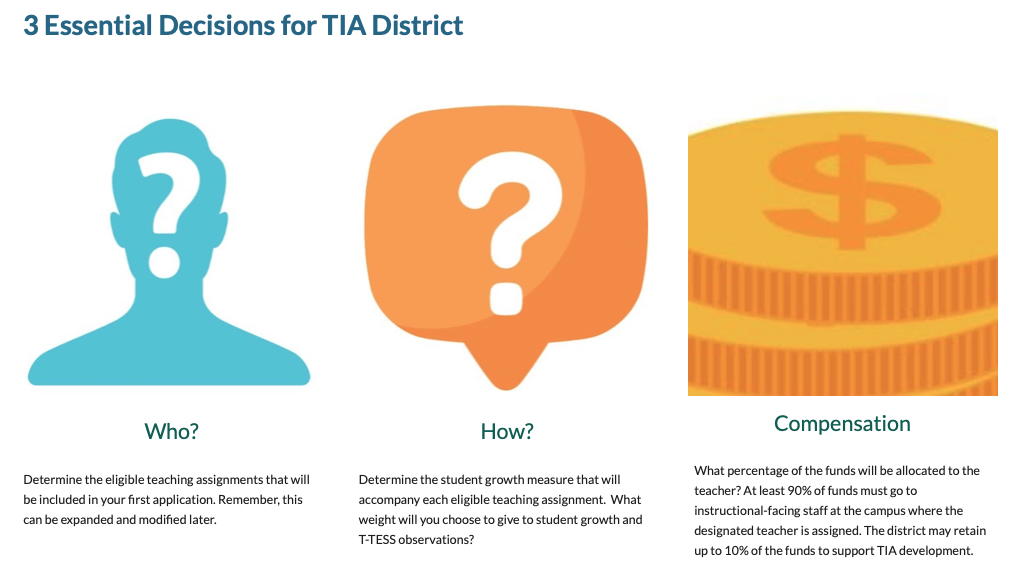
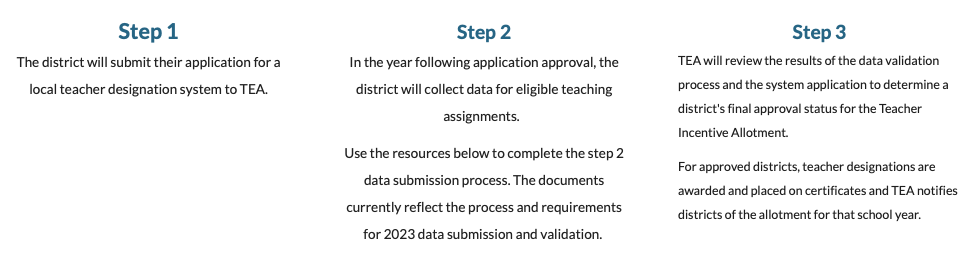
House Bill 3 provides districts with local control and flexibility in choosing how to evaluate teachers and assign designations. Developing a local teacher designation system requires significant planning, robust stakeholder engagement, adequate time to prepare all necessary materials for rollout and a strong communication plan prior to the first implementation year. Once a local designation system is approved, districts may recommend their effective teachers for designation. There is no limit to the number of teachers that a district may designate as long as their teachers meet the district’s designation criteria and the eligibility requirements under the rules defined by TEA.
At a minimum, the designation system must include both a teacher observation and a student performance component:
- Teacher observation based on T-TESS; a third-party rubric, such as the NIET TAP, Marzano, or Danielson rubric. District application must show evidence of validity and reliability.
- Student growth measures determined by district. Can include pre-and post-tests, value-added measures, student learning objectives (SLOs), and portfolios. District application must show evidence of validity and reliability.
- Districts can use other factors in determining the teachers eligible to receive a designation, such as student surveys, teacher leadership responsibilities, teacher mentorship responsibilities, family surveys, demonstration of district core values, teacher peer surveys, and contributions to the broader school community.
Local designation systems include a two-part verification. The system must be submitted to TEA for approval before undergoing a data-validation process, which will be conducted by Texas Tech University. As part of the validation process, Texas Tech will:
- Review alignment between teacher observation ratings and student performance ratings.
- Review alignment between student performance ratings and value-added ratings for applicable teachers.
- Review data validity by appraiser/rater, by campus, across campuses in a district, and by teaching assignment.
- Compare district data to state data by comparing the percentage of teachers a district puts forth for designation to overall district performance.
Districts receive the TIA allotment funding and must abide by the spending requirements by August 31st of each year.
Don't forget to check out the FAQ section at TIA Texas to better understand the TIA system.